Let's build
something
great together
Let's build
something
great together
Let's build
something
great together
Thanks for stopping by. Our team has extensive experience leading technical delivery for enterprise brands, and building thoughtfully designed software is our passion.
If you need help with software development, modernizing your AI workflows, or training your team to use agentic tools, we would love to connect.
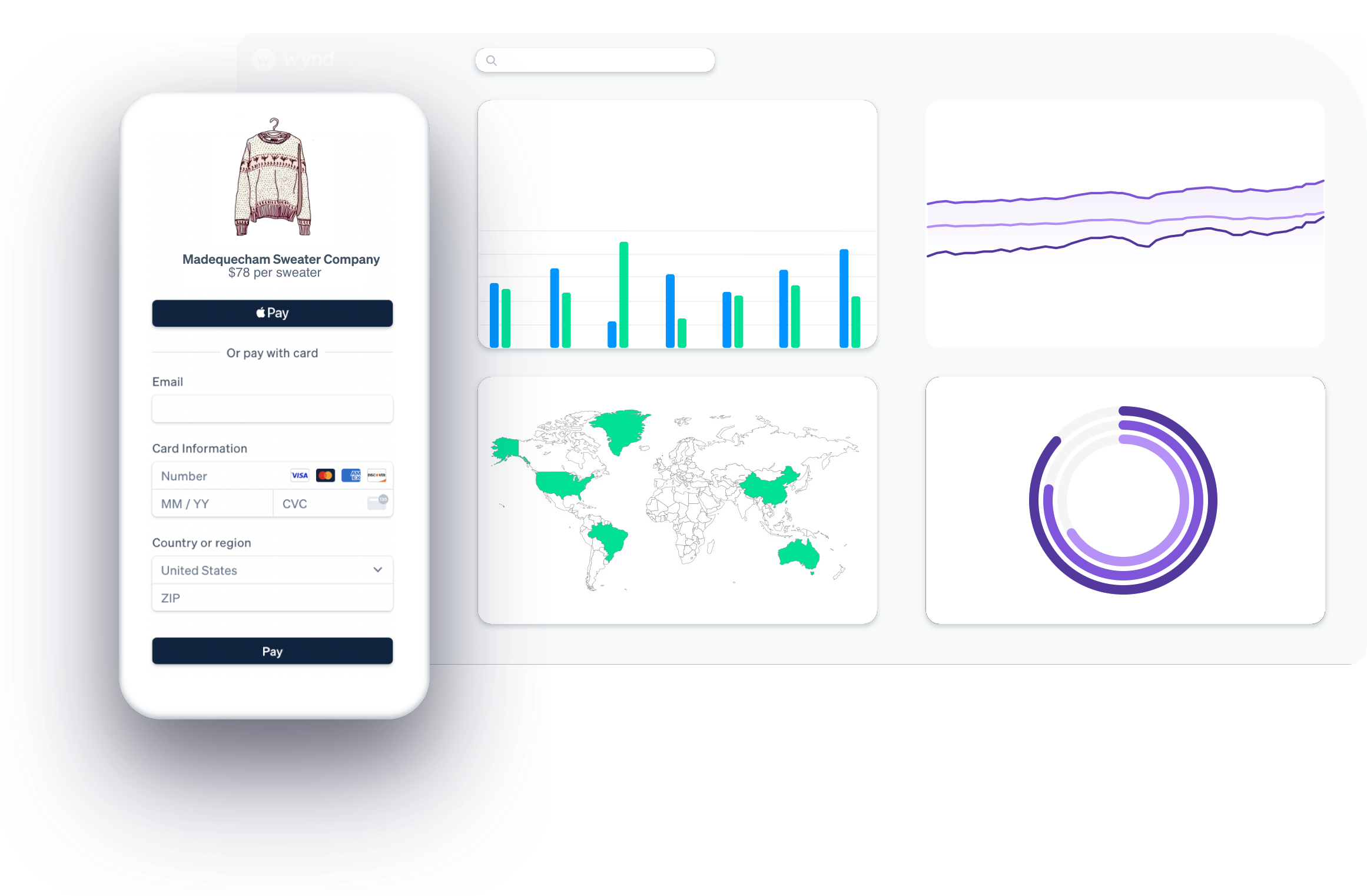
Some brands that we worked with at wynd, the company Cooper sold in 2020
Some relevant background
Form Factory is the engineering partner for some of Shopify's largest stores, including publicly traded companies like Turtle Beach and Solo Brands. As a data point some Form Factory partners generate more than $1B in annual revenue.
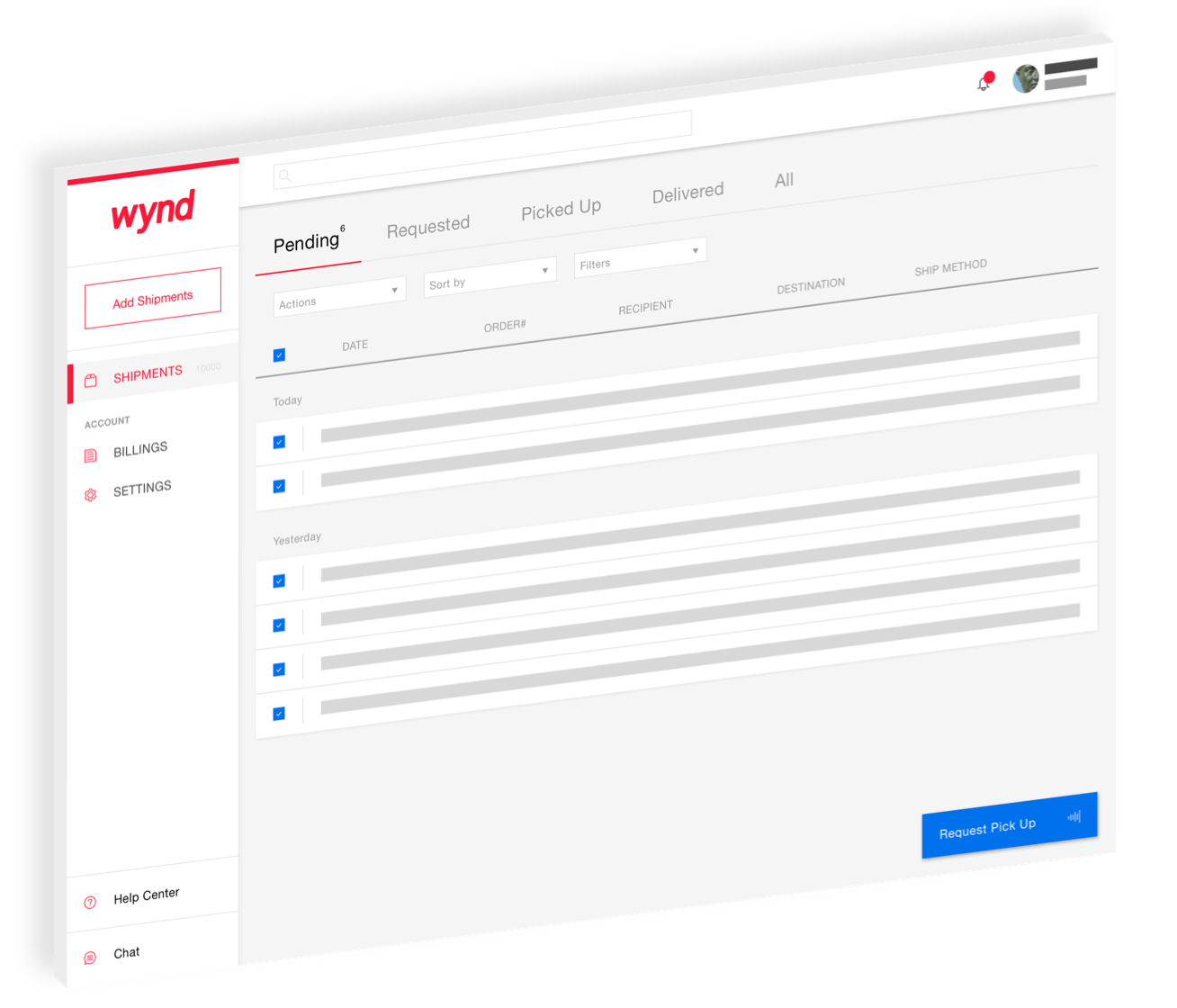
As the Chief Operating Officer at wynd, Cooper led the 2M+ annual revenue company to profitability, having assumed management of wynd when it was losing more than $130,000 per month. He improved gross margin from -29% to 45.8% (average gross margin pre-COVID), and eventually sold the company to Thor Equities.
Via the wynd technology platform, hundreds of thousands of orders were processed. Hundreds of thousands of shipments were fulfilled by wynd's fulfillment center, and tens of thousands of pickups and deliveries were completed by wynd's courier fleet. Millions of e-commerce checkout experiences benefited from wynd solutions.

In 2025 Spanx migrated Spanx.com to Shopify's Hydrogen framework. In light of the fact that Spanx generates hundreds of millions in annual revenue, their 2021 valuation ($1.2 billion [1]), and their influence as a globally recognized category leader, the migration is considered one of the highest-profile Hydrogen adoptions to date.
As the Technical Project Management Lead Cooper directed work execution across cross-functional teams of engineers, designers, product managers, and QA. He facilitated business and technical stakeholder alignment, converted complex product and technical requirements into actionable deliverables, and subsequently orchestrated and oversaw their delivery.
Spanx's leadership team classified the migration as a resounding success.
Building thoughtfully designed software is our passion
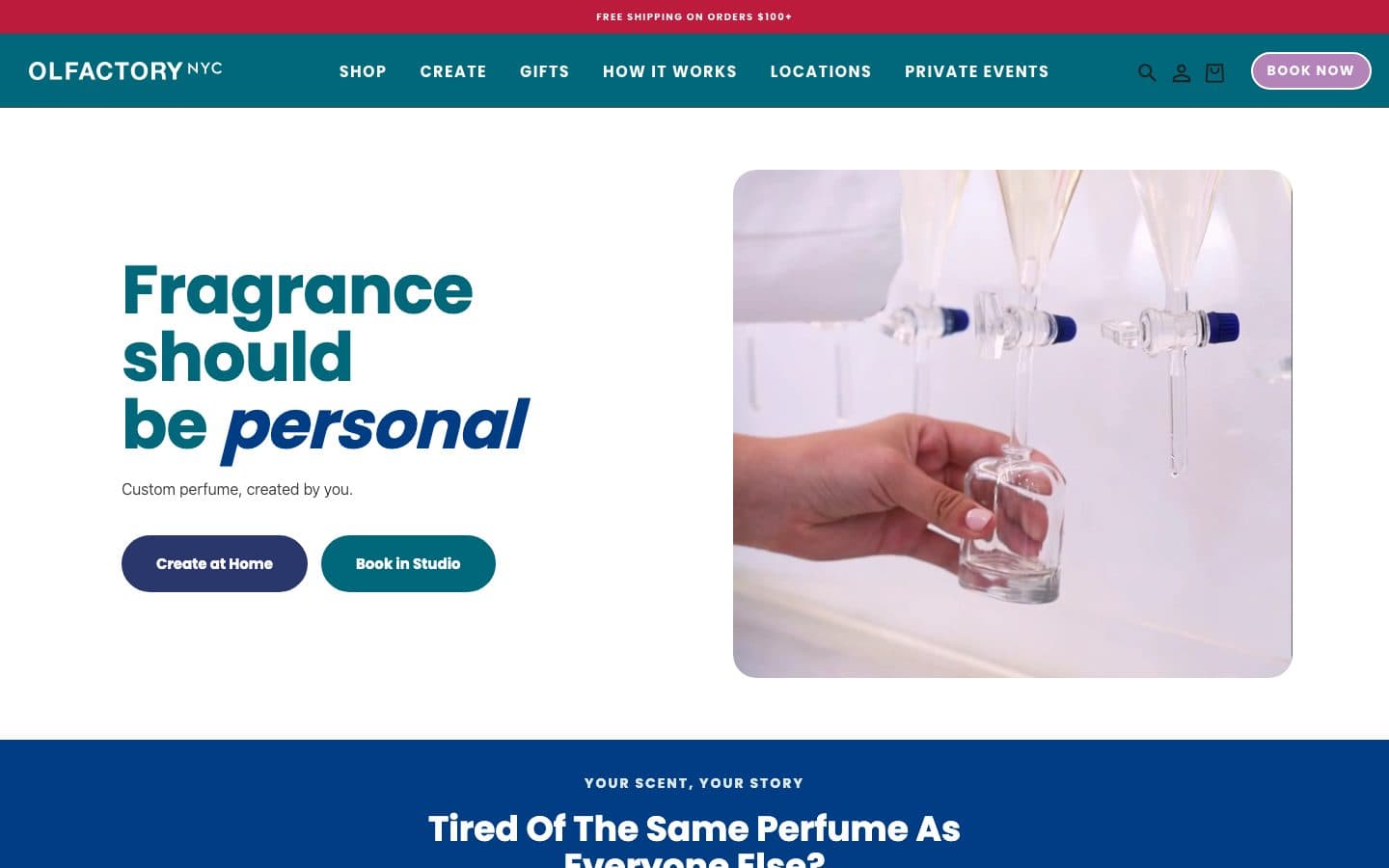
Olfactory is a New York-based fragrance company that helps customers create personalized perfumes online and at studio locations across the United States. Customers work with dedicated scent advisors to craft custom fragrances using blends developed by world-renowned perfumers and premium ingredients.
What began as rebuilding key marketing pages has grown into serving as Olfactory’s day-to-day engineering partner — the storefront, and seven production systems around it:
- The storefrontWe took over and now solely maintain the custom Shopify theme behind olfactorynyc.com: 150+ shipped pull requests spanning redesigned landing pages, structured data, SMS consent flows, and design tokens the brand edits themselves through Shopify metaobjects — no deploy required.
- The scent customizerA React application compiled straight into the theme’s assets, where customers compose a fragrance and personalize the bottle: a live engraving preview, schema-validated input, reorder-your-past-creation flows, and subscription logic.
- The AI scent builderA service that turns a customer’s story into a valid, purchasable blend from the live catalog: model output held to a strict JSON schema, validated server-side against real product data, every composition retained in Postgres.
- Appointments & operationsA Next.js and Postgres dashboard unifying every studio’s bookings into one calendar, with per-location capacity targets, a check-in roster, and an SMS waitlist that texts through Klaviyo only after consent is recorded. Role-based accounts with email verification; Sentry watching every error.
- In-store checkoutA Shopify POS extension associates use at the register to capture custom-scent details: first commit to storewide launch in five weeks, an order-webhook observer repairing records behind it, PostHog measuring real usage, and a live production-reporting view with protected CSV export.
- Event captureAn offline-tolerant iPad app for retail pop-ups: captures persist on-device through flaky venue Wi-Fi, sync to the customer’s Shopify profile, and surface in a customer-account extension so shoppers can reorder their saved scents.
- Sales reportingA per-studio sales-and-tips dashboard that takes every money line from Shopify’s own reports through a serverless GraphQL proxy with short-lived credentials, PIN-scoped by location and reconciled to match Shopify exactly.
- Marketing middlewareA Laravel service between Shopify and the CRM: gifting workflows that track purchaser and recipient in Klaviyo, and store-credit operations backed by a reconcile job that detects drift, backfills, and can roll itself back.

Altius Immigration Law is a Washington, DC immigration firm serving clients in English, Spanish, and Portuguese. We rebuilt altius.law from WordPress into a custom Next.js site and ran the cutover — same content, all three languages.
Measured on the live site with analytics running: first content in 3.6 seconds where WordPress took 18.5 — five times faster — layout shift while loading eliminated, and three of Google Lighthouse’s four categories at a perfect 100, with Best Practices up from 46. The site also scores 94/100 for agent readiness, built to be read by the AI assistants people increasingly ask instead of a search box.
The speed took a day to measure. The lasting change is velocity: a federal immigration rule published one morning had its article live by lunchtime — and every page is re-measured weekly, with a report only when something actually moved.
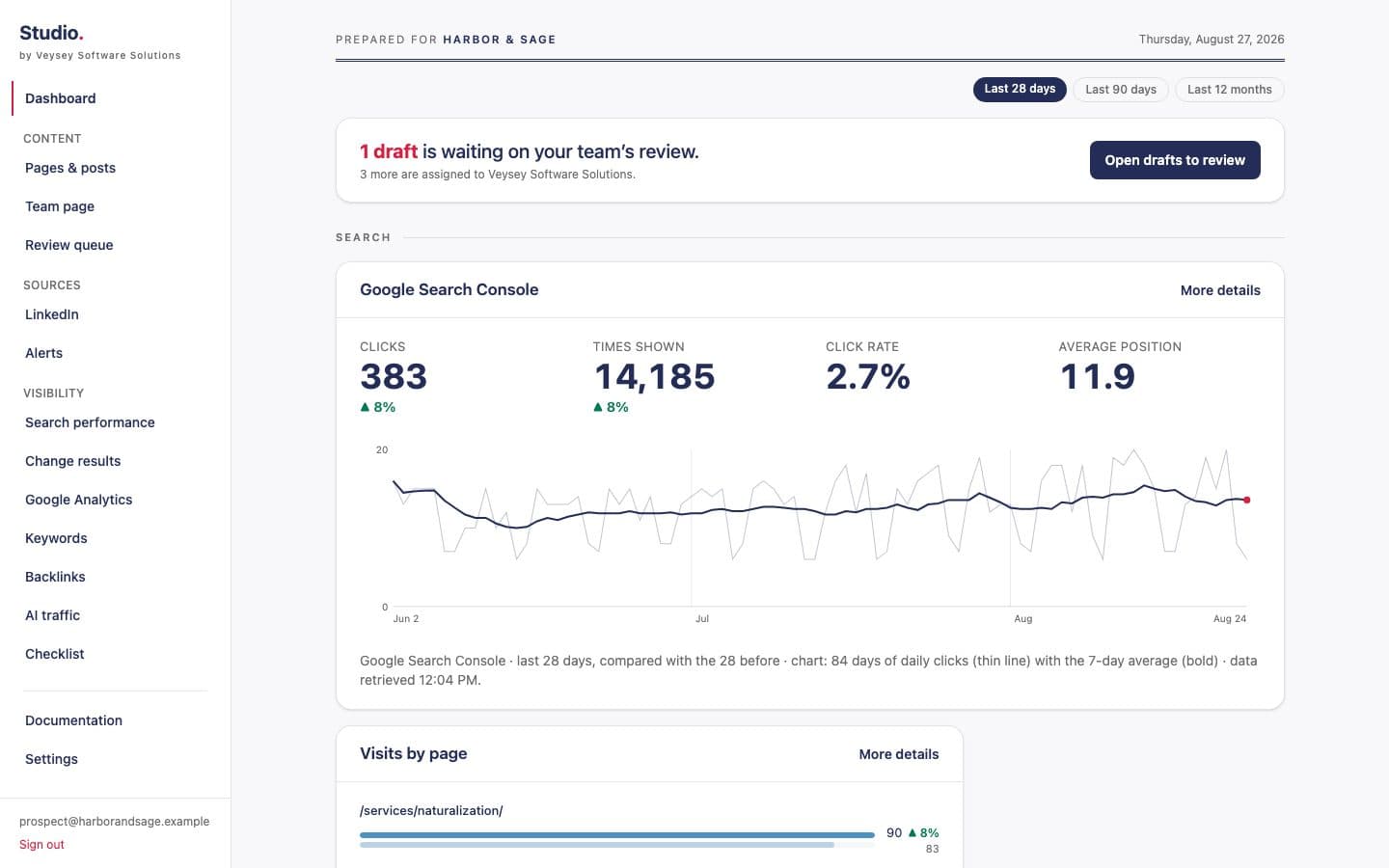
Content Studio is the authoring and measurement platform we built for the sites we run with our partners. Each partner signs into a private workspace where every proposed page arrives as a brief — what we’re proposing, the argument for adding it, primary sources, and a completed plagiarism check — and nothing reaches the live site until they approve it.
Then it measures what the writing actually did. Search performance and analytics sit alongside two things ordinary tooling doesn’t do: AI-assistant traffic logged at the server itself — reads by ChatGPT, Claude, and Perplexity that never appear in normal analytics — and a standing checklist that continuously re-verifies the site’s health, down to Core Web Vitals from real visitors. Every published change is scored against the whole site’s movement over matched windows, so “this page is working” is a claim the numbers can check — and the Studio says so honestly when they can’t.
One deployment serves every partner, with Postgres row-level security keeping each workspace strictly isolated. The preview above is the demo — a fictional immigration firm, Harbor & Sage — and it’s browsable: expand it and click through the dashboard, the review queue, change results, and analytics. Drafting works end to end, and anything that would spend money or publish explains what it would do on a production Studio instead.
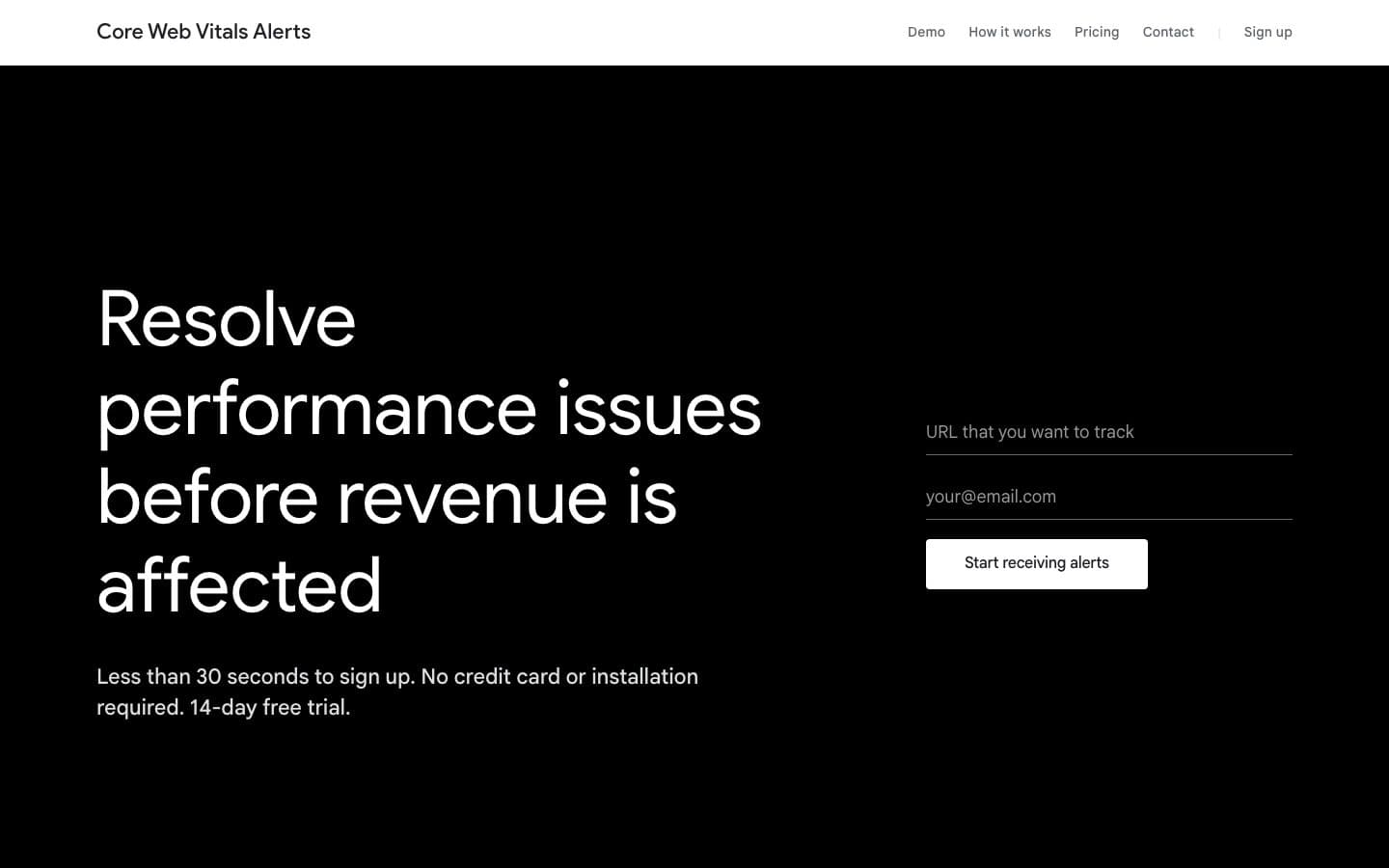
Core Web Vitals Alerts is a performance optimization solution that alerts teams when performance metrics degrade past designated thresholds. It continuously monitors lab and field data from Google, and alerts teams when Core Web Vitals metrics enter Google’s “Needs Improvement” or “Poor” ranges.
The product serves as infrastructure for an end-state solution via which autonomous agents continuously analyze performance data, reason about optimization opportunities, and deliver validated improvements through automated pull requests and testing.
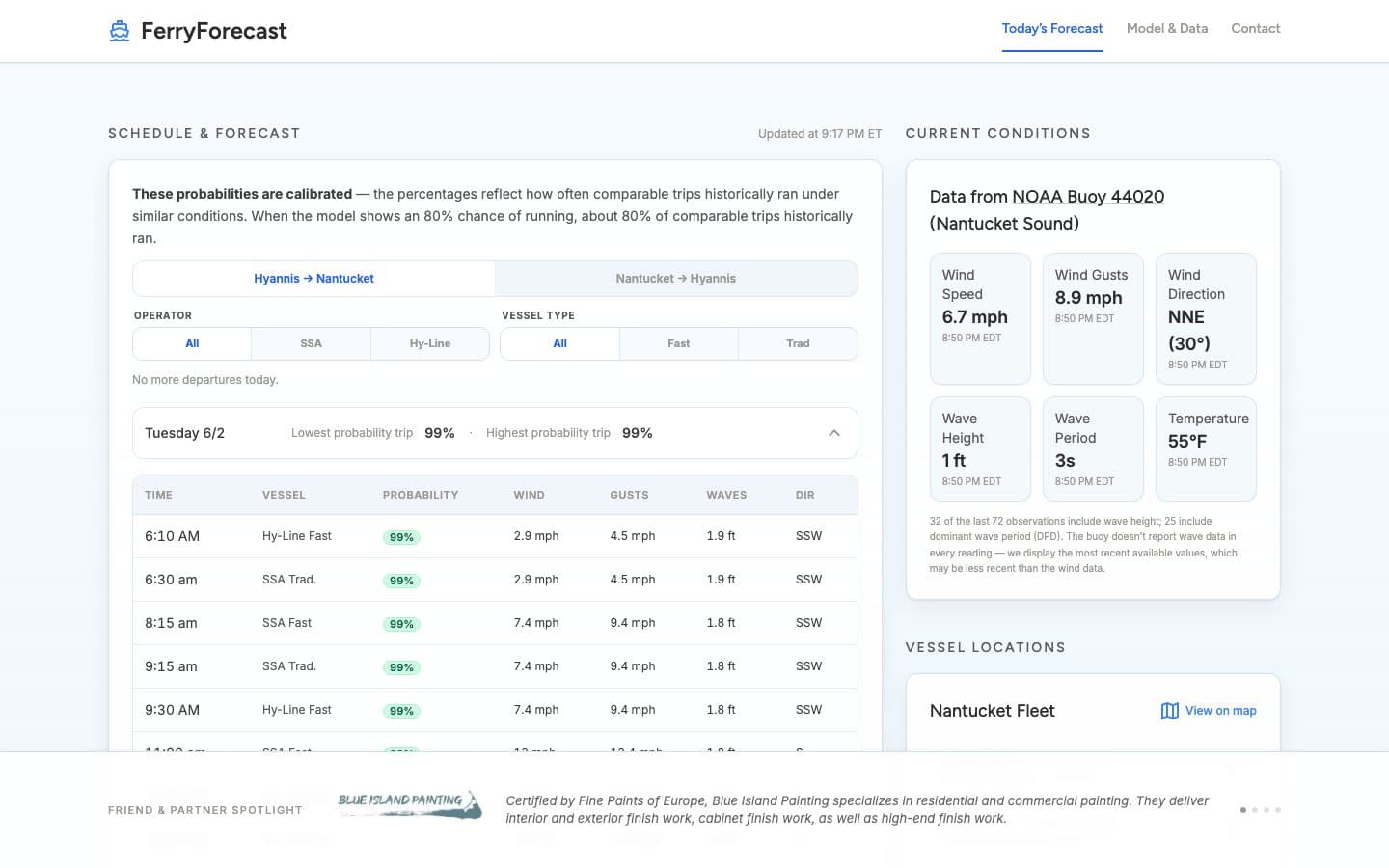
FerryForecast predicts, for every scheduled departure on the Nantucket–Hyannis crossing, whether the boat is likely to run — from live NOAA buoy conditions and a model trained on more than 33,000 historical trips.
The numbers are built to be trusted: ground truth is reconstructed from operator logs, service alerts, and AIS vessel records, then reconciled against the operator’s own published performance data. The model ships with its cross-validated accuracy attached, its probabilities are calibrated — when it says 80%, about 80% of comparable trips historically ran — and every forecast explains which conditions moved it.
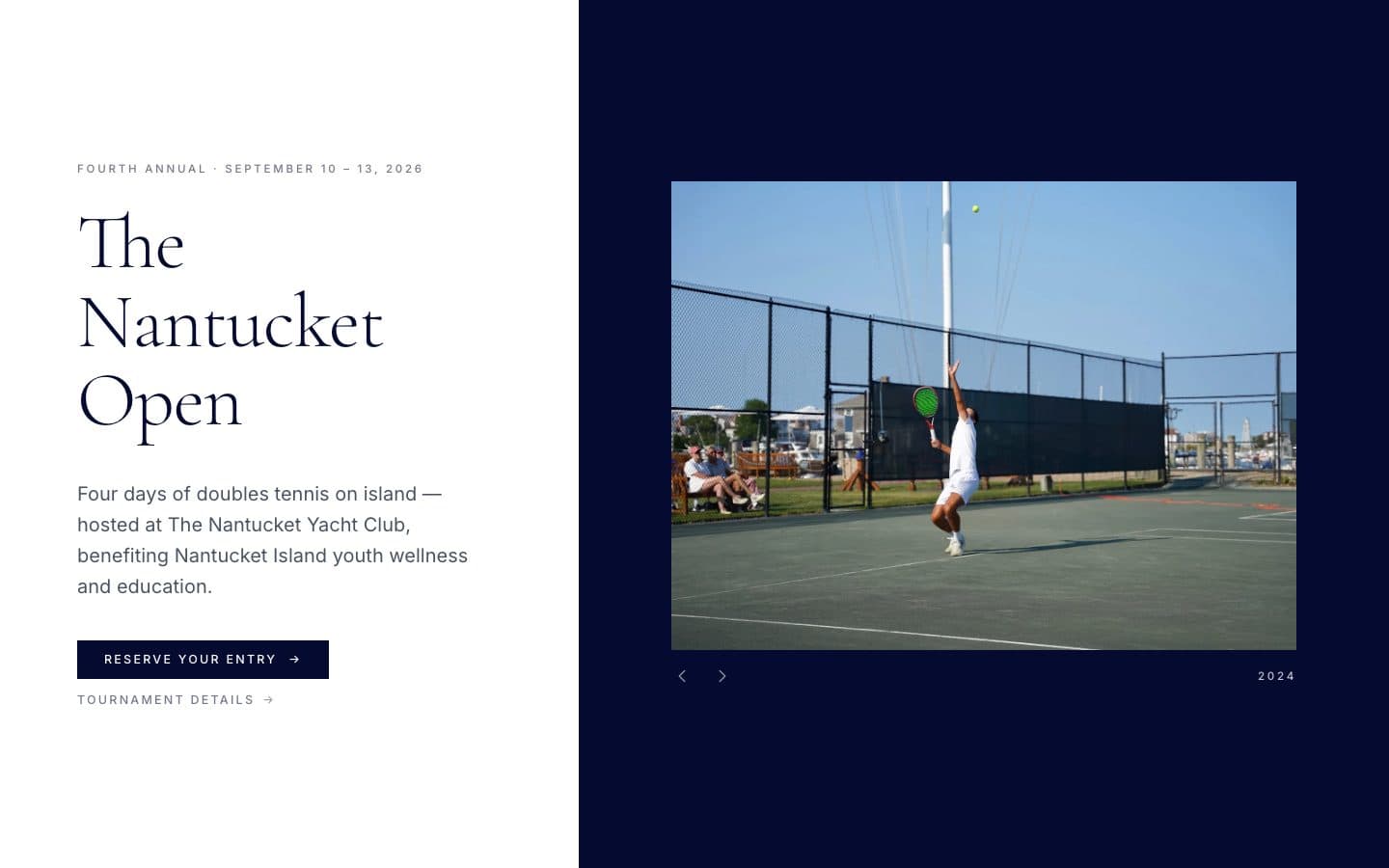
The Nantucket Open is Nantucket’s all-island doubles tennis tournament, a tradition dating back to 1977. We designed and built nantucketopen.org end to end.
Registration is a small payments system done properly: Stripe Checkout with prices set server-side under a scoped restricted key, fulfillment driven by signature-verified webhooks that fire only on a succeeded payment, every entry logged to the tournament’s roster with refunds tracked, and branded confirmation emails to the player, their partner, and the organizers. The payment path is covered by tests, with Sentry watching it in production.
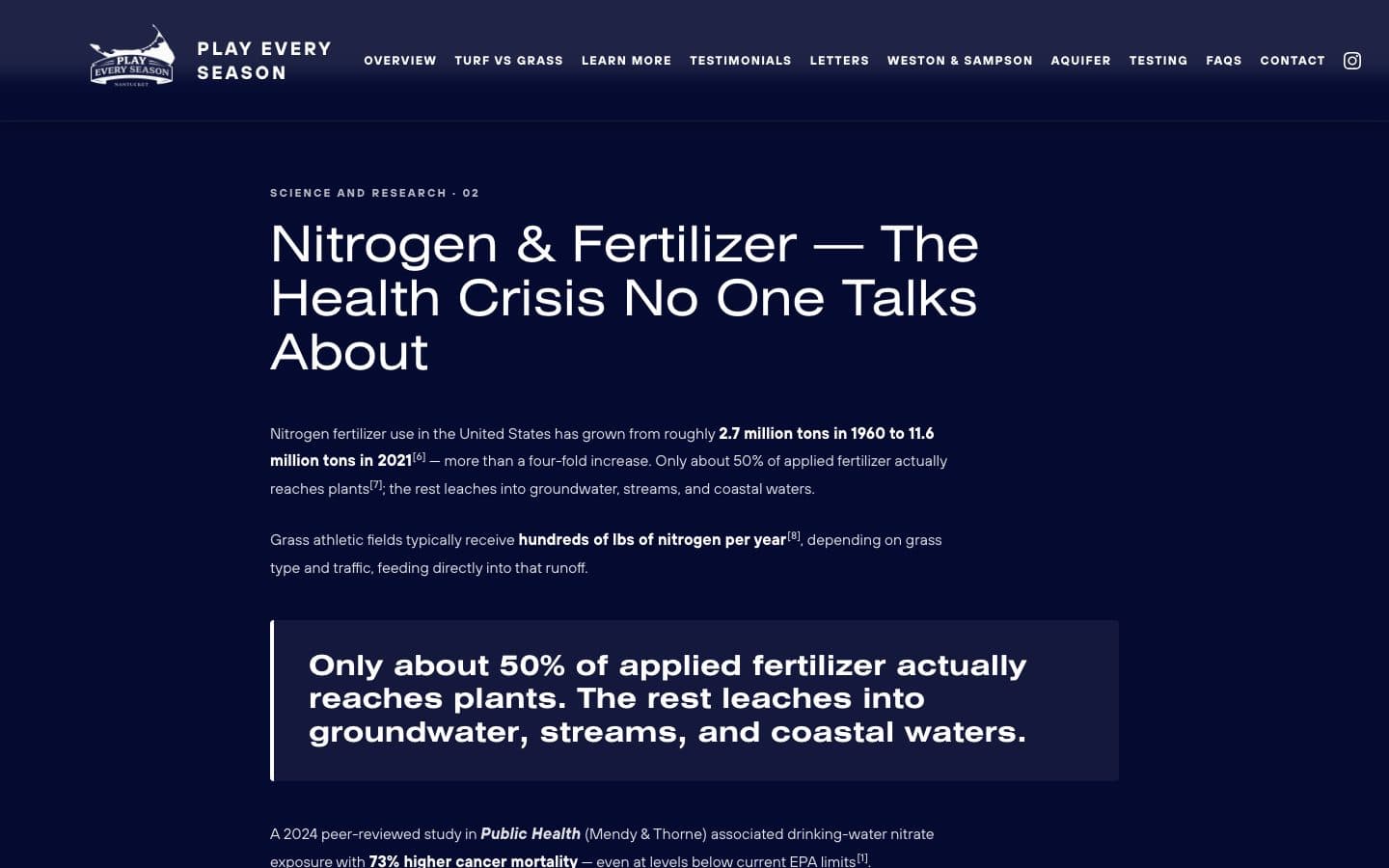
PlayEverySeason.com was a civic advocacy resource built for Nantucket’s 2026 Annual Town Meeting and Annual Town Election. It focused on Article 12 and Question 2, which asked voters to appropriate $25 million for improvements to Nantucket Public Schools’ athletic facilities. The measure ultimately passed at both Town Meeting (719–281) and the Annual Town Election (1,773–1,208).
Built by a group of volunteers that care deeply about Nantucket, PlayEverySeason.com synthesized scientific research, environmental studies, public records, and community perspectives into an accessible resource for voters.
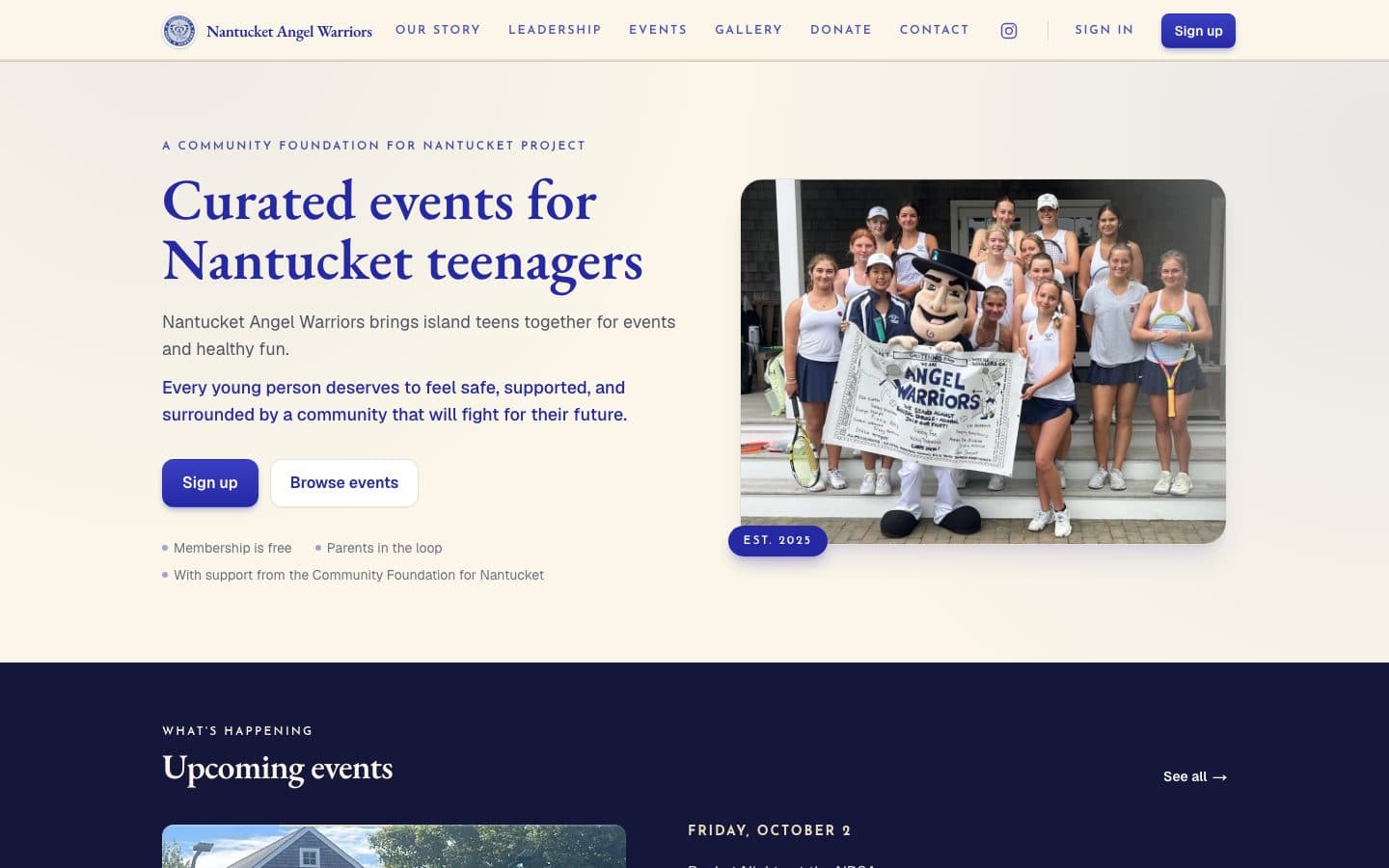
Nantucket Angel Warriors, a Community Foundation for Nantucket project, brings island teens together for curated events — padel and pickleball at the Nantucket Racquet Sports Association, tennis at Great Harbor Yacht Club, cooking classes at Cafe 22, painting and drawing classes with local artists, and time with the staff of The Inquirer and Mirror for a first look at journalism — across eleven partner venues, including Dreamland and the Westmoor Club. We designed and built nantucketangelwarriors.org, from the public site families see to the tools organizers use to run their programming:
- One-tap sign-up, with waivers parents sign on their phoneA teen registers in a tap. Their parent is emailed straight away with a link to sign the waiver on their phone — no account needed — and gets a copy of what they signed. If it is still unsigned as the night approaches, the app asks again a week out, two days out, and the morning of.
- Notifications delivered to the right people at the right timeOrganizers hear when a teen or parent joins, when a venue host adds or changes an event, and when a night fills up; hosts hear when their own night is full. Teens get reminders for events that they register for.
- Organizers send announcements from their admin dashboardWhen weather cancels a night, an organizer picks who should hear — the teens, their parents, or both, for one night, a whole program, or everyone — sees exactly how many people that is, sends themselves a test, and sends. Three plain-language steps, built for volunteers who don’t live in software.
- A printable QR code for every event, and check-in from a phoneThe code goes on a table card or poster and opens that night’s sign-up page. The adult running the night checks teens in from a link on their phone, with each guardian’s number a tap away.
- Every family-facing page in English, Spanish, Portuguese, and BulgarianFor Nantucket’s year-round families. A phone set to one of those languages opens the site in it automatically.
- Emails from the program’s own domain, with search and analytics set upAdded alongside the organization’s existing mail without touching it. Google Search Console and a sitemap help families find the site, and PostHog analytics masks on-screen text before anything is recorded.